In a nutshell, Continuous Verification is about putting as many automated checks as possible into your CI/CD pipelines. These checks call out to external systems to validate performance, security, and cost — without asking your engineers to do that manually. The same systems that decide whether a deployment goes to production can also help engineers understand where the bottlenecks are. More checks in the pipeline means fewer manual tasks, less overhead, and better decisions about what actually ships. And yeah, maybe a bit more time at the beach.
Knative builds on Kubernetes to abstract away complexity for developers, and enables them to focus on delivering value to their business. The complex (and sometimes boring) parts of building apps to run on Kubernetes are managed by Knative. In this post, we will focus on setting up a lightweight environment to help you to develop modern apps faster using Knative.
At VMware we define Continuous Verification as:
“A process of querying external systems and using information from the response to make decisions to improve the development and deployment process.”
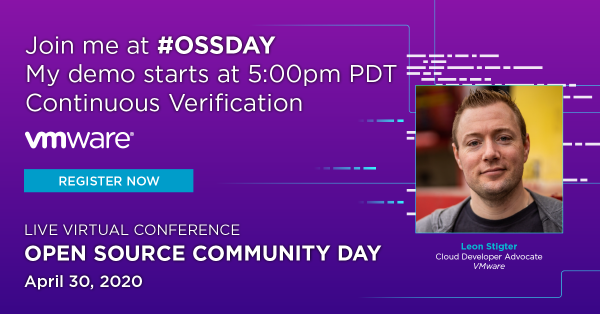
At #OSSDay, I got a chance to not only talk about what that means for serverless apps and how you can build it into your existing pipelines using tools like GitLab, CloudHealth, Wavefront and Gotling.
If you’ve read the blog posts on CloudJourney.io before, you’ve likely come across the term “Continuous Verification”. If not, no worries. There’s a solid article from Dan Illson and Bill Shetti on The New Stack that explains it in detail. The short version: Continuous Verification means putting as many automated checks as possible into your CI/CD pipelines. More checks, fewer manual tasks, more data to smooth out and improve your development and deployment process.
So far we covered the tools and technologies, Continuous Integration, and Infrastructure as Code aspects of the ACME Serverless Fitness Shop. This post is about observability.
If you’ve read the blog posts on CloudJourney.io before, you’ve likely come across the term “Continuous Verification”. If not, no worries. There’s a solid article from Dan Illson and Bill Shetti on The New Stack that explains it in detail. The short version: Continuous Verification means putting as many automated checks as possible into your CI/CD pipelines. More checks, fewer manual tasks, more data to smooth out and improve your development and deployment process.
In part one we covered the tools and technologies and in part two we covered the Continuous Integration aspect of the ACME Serverless Fitness Shop. This post is about Infrastructure as Code.
If you’ve read the blog posts on CloudJourney.io before, you’ve likely come across the term “Continuous Verification”. If not, no worries. There’s a solid article from Dan Illson and Bill Shetti on The New Stack that explains it in detail. The short version: Continuous Verification means putting as many automated checks as possible into your CI/CD pipelines. More checks, fewer manual tasks, more data to smooth out and improve your development and deployment process.
If you’ve read the blog posts on CloudJourney.io before, you’ve likely come across the term “Continuous Verification”. If you haven’t, no worries. There’s a solid article from Dan Illson and Bill Shetti on The New Stack that explains it in detail. The short version: Continuous Verification is “A process of querying external system(s) and using information from the response to make decision(s) to improve the development and deployment process.”
Microservices give us as developers an incredible amount of freedom. We can choose our language and we can decide where and when to deploy our service. One of the biggest challenges with microservices, though, is figuring out how things go wrong. With microservices, we can build large, distributed applications, but that also means finding what goes wrong is challenging. It’s even harder to trace errors when you use a platform like AWS Lambda.
At VMware we define Continuous Verification as:
“A process of querying external systems and using information from the response to make decisions to improve the development and deployment process.”
At Serverless Nashville, I got a chance to not only talk about what that means for serverless apps but also how we use serverless in some of the business units at VMware.