If you’ve read the blog posts on CloudJourney.io before, you’ve likely come across the term “Continuous Verification”. If not, no worries. There’s a solid article from Dan Illson and Bill Shetti on The New Stack that explains it in detail. The short version: Continuous Verification means putting as many automated checks as possible into your CI/CD pipelines. More checks, fewer manual tasks, more data to smooth out and improve your development and deployment process.
If you’ve read the blog posts on CloudJourney.io before, you’ve likely come across the term “Continuous Verification”. If you haven’t, no worries. There’s a solid article from Dan Illson and Bill Shetti on The New Stack that explains it in detail. The short version: Continuous Verification is “A process of querying external system(s) and using information from the response to make decision(s) to improve the development and deployment process.”
Microservices give us as developers an incredible amount of freedom. We can choose our language and we can decide where and when to deploy our service. One of the biggest challenges with microservices, though, is figuring out how things go wrong. With microservices, we can build large, distributed applications, but that also means finding what goes wrong is challenging. It’s even harder to trace errors when you use a platform like AWS Lambda.
At VMware we define Continuous Verification as:
“A process of querying external systems and using information from the response to make decisions to improve the development and deployment process.”
At Serverless Nashville, I got a chance to not only talk about what that means for serverless apps but also how we use serverless in some of the business units at VMware.
DevOps, as a practice to build and deliver software, has been around for over a decade. What about adding security to that, though? After all, security is one of the cornerstones of today’s information technology. As it turns out, one of the first mentions of adding security was a Gartner blog post in 2012. Neil MacDonald wrote,
“DevOps must evolve to a new vision of DevOpsSec that balances the need for speed and agility of enterprise IT capabilities (…)”.
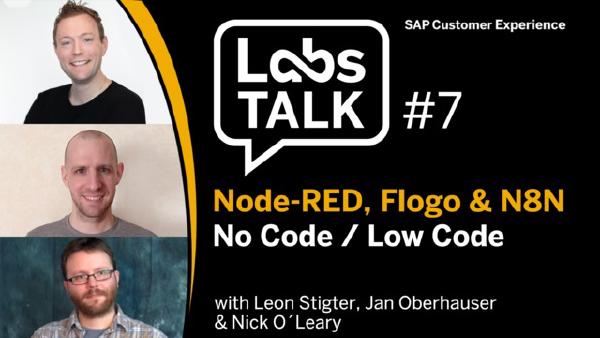
One of my strong beliefs is that coding should be available to everyone. Whether that is a seasoned developer or someone who just wants to connect two systems together. With Project Flogo, we’ve made it possible for everyone to use the same constructs. If you want to use the web-based flow designer, that’s awesome! If you want to write your apps using the Go API, that’s awesome too. In this podcast I joined Jan Oberhauser (N8N), Nick O’Leary (Node Red), and the SAP Customer Experience Labs team to discuss No Code / Low Code.
When I started this series on creating infrastructure as code on AWS with Pulumi, I knew the team was actively improving Go support. What I didn’t expect was how quickly those improvements would land and how much cleaner the code would get. This post revisits some of the earlier code and updates it to the new SDK.
I’ve used Pulumi to do a bunch of things so far: creating subnets in a VPC, building EKS clusters, and DynamoDB tables. The one thing I hadn’t tried yet was deploying Lambda functions, so that’s what this post covers.
As a developer, I’ve built apps and wrote code. As a cheesecake connoisseur, I’ve tried many different kinds of cheesecake. After I got to talk to some of the bakers, I realized that building apps and baking cheesecake have a lot in common. It all starts with knowing and trusting your ingredients.
According to Tidelift, over 90 percent of applications contain some open source packages. Developers choose open source because they believe it’s better, more flexible, and more extendible. A lot of developers also fear how well packages are maintained and how security vulnerabilities are identified and solved.